Showing posts with label New rules. Show all posts

Monday, June 13, 2016

5e D&D - Group Checks and Group's Average Checks


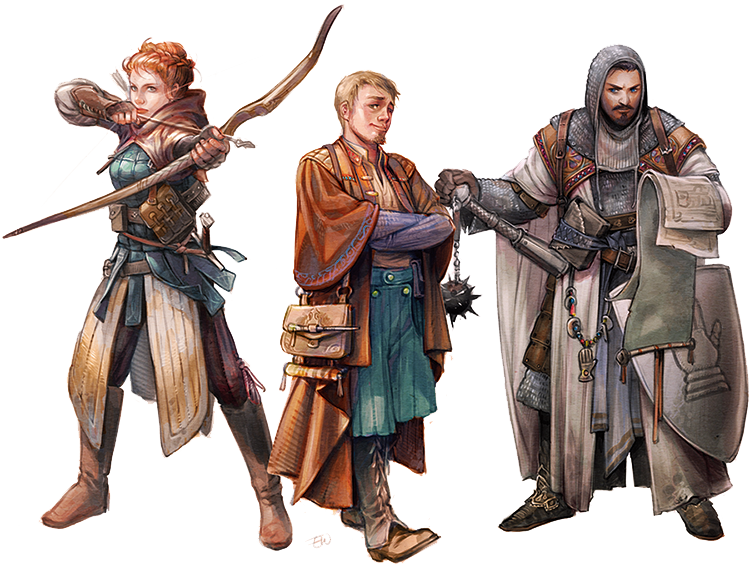
A party of adventurers making a group survival check

The PHB tells to use Group Checks when a number of individuals are trying to attempt something as a group and they will either all fail or all succeed. In the rules, it says that to do a group check all involved must make the check as usual. If half of the group succeeds, then all the group succeeds. I would like to expand on these explanations a little bit analysing the possible uses of Group Checks and, in the end of the article, propose a variation of roll using the average of all characters' skills instead of rolling for each of them separately.

Saturday, June 11, 2016

5e D&D - Combat options with Giant Creatures


I've already discussed in this blog how hard it is to find interesting rules in rpgs that emulate the power and danger that a giant creature offers in battle. It is always mistifying to me how in many combat rules, giants act so illogically. Instead of grabbing and trampling all over their puny opponents, most of the time they stay still, just throwing a few melee attacks here and there. In D&D 5e, the DMG offers the chance for smaller characters to grab unto a giant's back. It is an interesting take, but nevertheless lacking in regards to how a giant creature can act to trash their enemies.

Friday, June 10, 2016

5e D&D - Magical Forges: adding weapon and armor upgrades to your game


Skyrim, Diablo, Dark Souls, Path of Exile, Salt & Sanctuary, and many, many other games have some interesting mechanics to deal with the improvement of items. Sometimes using socketed gems, or the character's skill with a forge, or finding magic runes or using arcane enchantments, there are many ways a character can improve its items.

Thursday, June 9, 2016

5e D&D tweaks - core character classes balance


Overall, all classes in 5e are very well made and balanced. The new skill system, the varied paths a player can choose, the increase of some classes hit die, like the arcane spellcasters going from a d4 to a d6 and the rogue going from a d6 to a d8 - all of that contributed to make the game interesting and balanced. 


Wednesday, June 8, 2016

5e D&D Tweaks - Abilities scores, checks and Saving throws rethinking


Today, I'd like to discuss a few tweaks, rethinking and house rules I use in my games with Attribute scores, attribute checks and Saving Throws.

Friday, August 29, 2014

OSR extras (9) – Double Handling, Dual-wielding and Focus tactics, new rules


I would like to present some nifty and simple tactics to be used in OSR games. They are very easy to implement and may give some flavor and variety to attacks.

Double Handling (Full-force attacks): Very common in many games (like Dark Souls), double handling means using two hands instead of one when using a weapon, augmenting its damage output. In mechanical terms, when double handling, your attack suffers -2 penalty, but increase the size of the damage die by 1. So, a dagger (d4) would cause d6 damage, a short-sword would cause 1d8 damage and a long-sword would cause 1d10 damage. Weapons that are naturally two-handed could also be 'double-handled', although what this means is that the user would attack with 'full-force', increasing the dice damage (a great sword would deal 1d12 damage instead of 1d10, fro example).

Dual Wielding: I would like to present some slightly different rules from the main book for dual-wielding. In real life, dual-wielding was an odd style, mostly used in special situations, normally duels and probably never in real army combat. The second weapon functioned also principally as a form of 'shield' instead of a second form of attack. The nature of dual wielding makes effectively using the weapon extremely hard and, specially if the weapons are both big or of the same size. So, to emulate those characteristics in your game, dual wielding function as a shield, giving +1 AC, but you receive a penalty in your attack depending on the size of the weapon used in your off-hand (so, a tiny weapon give 0 penalty, a small gives -1, a medium -2 and a great weapon giver -4). Besides that, if you want to attack with both weapons in a turn, the main-hand weapon receives another -2 penalty and the off-hand weapon receives -2. So, if you are using a small sword in your off-hand, you naturally receives -1 to attack. If you want to attack with both weapons, you will receive -3 in your main hand and -5 in your off-hand.

Focused Attacks: Waiting for striking the right place in order to deliver a critical strike. With that tactic, you suffer -2 to your attack, but increase the critical margin by 1 (normally, this means that the hit is critical on either 19 or 20 instead of only 20) and the damage multiplier by 1 (so, it's 3x damage instead of 2x). This tactic can be used to either ranged or melee attacks.

Weapon proficiency: If you are using the skill rules for weapon proficiency, a character that puts a point in any of those tactics will receive +2 to using them. So, focus and force attacks will have no penalty, for example.

So, what you folks think? I like giving options to my players attacks so everything don't fall into the boring 'I attack' action. I will be posting more tactics eventually.

Until next time,
Valete!


Images 1, 2

If you liked this post, you may help me improve by sharing it in your social networks. Also, if you are curious, give it a look at my others works and consider becoming my patreon.


Thursday, August 28, 2014

OSR Extra (8,5) - More about Shields and Blocking, rules


I was surprised in my last post that many people discussed  and commented in the rpg groups about their ideas of using shields and blocking. Since many of those ideas were very interesting, I wanted to present them here in the blog in a concise way and see what you folks think.

Option 1, Bonus to AC and Saving throw: This was the option people talked the most - instead of having another roll for blocking (which would slow the game), have the bonus be applied to AC (+1 Bucklers, +2 Small, +3 Medium, +4 Big) and also to relevant Savint Throws (like, for example, using a shield to block the fire from a dragon's breath or a fireball). This option is faster than rolling for block to every and each attack and I liked it very much. However, some said that the AC bonus should be lower (Bucklers and Small shield +0, Medium and Big shields +1), but the Saving Throw bonus apply normally. That is a rule to playtest and I would be interested in knowing what you folks find of it.

Option 2, Random bonus to AC: Proposed by Lucas in the PT version of the blog, to reflect the nature of blocking one could roll 1d4 for small shields, 1d6 for medium and 1d8 for big and add the number to their AC. That is similar to the rules I said in my last post, but I think it to be too random in the AC department. Nevertheless, an interesting idea to share.

Option 3, 'Combat Options': The AD&D book of combat options gives a lot of possibilities for shields, but most of them are related to spending the action in blocking and whatnots. It is a very interesting read, but I personally don't like it. I prefer 'automatic' and 'always active' effects instead of having to declare your action of blocking. But it is a very interesting read and anyone curious should take a look on it.

Option 4, 'Cover': Shields would offer a cover percentage relative to how much of the body they cover (Bucklers 10%, Small Shields 20%, Medium Shields 50%, Big Shields 75%). Every time it seems that the Shield could block an attack, the GM may roll the cover and, if lower or equal, then the attack fails. Melee attacks reduce the cover to half its normal value.

<<>>

Those were the options to the 'Blocking with Shields'. However, besides that there are also extras that you can apply to every option. 

Extra 1, Shields and Attacking: Using shields greatly hampers one's ability to fight. So, if you apply this extra to one of the options, reduce the user Attack by 1 per level of the shield (so, a buckler would reduce an attack in -1, a medium shield in -3 etc.).

Extra 2, Big creatures and attacks from behind: If a creature is too big, blocking is useless (GM's call for when a creature is too big). If the character is surrounded by many foes, those that surpass the shield (attacking from behind or flanking where the shield does not protect) will not suffer the block effect. That should not be something hard to deal with - no need for a combat grid. Just use common sense, like when the character is surrounded by goblins, some of the goblins will just get through the shield.


'Turtle Formation'
Extra 3, 'Turtle Formation' and hiding behind a shield or barrier: If you are hiding behind an object, you should apply the 'Cover' rules mentioned above, with a percentile chance of the attack being intercepted. Just have the attack be made against you normally and, if it goes beyond your AC, have an approximate value of how much of the body is vulnerable and roll a percentile die. For example, in a turtle formation, you'd have only 10% of your body exposed (the low part of your ankles and the gaps between the shields). This makes very hard for archers to hit well protected and trainned warriors. 

And that is it, folks. This is what was discussed in the many groups, both in PT and EN. I hope yall liked it and, if you use any of those options, tell me how did they fare in your game. I'm specially curious with Option 1 and 4 and I hope to test them myself.

Until next time,
Valete!

Images 1, 2, 3

If you liked this post, you may help me improve by sharing it in your social networks. Also, if you are curious, give it a look at my others works and consider becoming my patreon.

Tuesday, August 26, 2014

OSR extras (8) - Shield and Blocking, new rules


One of the things that I never liked much in Old School combat is the way Shields are treated. In our world, shields were always extremely important in the ancient battle field, since skirmishing was a very common practice. The armies would trade projectile shots - stones, javelins, arrows - and a single hit on the knee or the head could be enough to take a warrior out. Therefore, shield were very important to impede or halt such conecting projectiles and, not only ranged attack, but melee attacks could also be averted by the proper usage of shields - and I'm not even talking about special tactics, like the turtle formation or the hoplite stance!

But in Old School systems, normally shields make only a very small impact, giving +1 AC for melee combat and +2 for ranged. Such defense does not reflect the way that shields were used in real combat. However, there is a very special old english rpg named Dragon Warrior that had some very interesting rules for shields and, inspired by it, I will discuss now some new rules for Shields and Blocking in OSR systems.

Shields would no longer give bonus to AC, but would have a Block Value. Bucklers would have 1, Small shields 2, Medium Shields 3 and Big Shields 4. Every time  an attack against a warrior using a shield hits through the AC, then the attacking creature should try rolling higher than the block value of the shield. If it is a ranged attack, the attacker rolls 1d6, if it is melee, roll 1d8. If it the roll fails, then the attack causes no damage.

And, although historically people did not use two shields (at least I don't know of it), we may accept something like that in a heroic fantasy game. So, if someone is using two shields, all attackers must roll two times against the block value - once for each shield - and be successful in both in order to damage the opponent.

Remorhazes are awesome!
If the attacking creature is big or too strong, then it rolls 1d12 against the Block Value. If the creature is gigantic (2 size categories bigger) or extremely strong, then blocking is impossible. So, an ogre attacking a warrior would roll 1d12 against the shield's Block Value, but a Remorhaz would just ignore it. However, if the warrior has some magical mean to improve his strength - like a Belt of Hill Giant Strength - then the GM might allow a block chance.


Blocking a fire strike
with a Shield
For different attacks, like rays of frost, fire strikes and whatnots, the GM may allow a block roll too, in the same way as per other attacks, choosing a die size relevant for the situation (a giant flame strike would roll 1d12 agains the Bloc Value, for example). In the end, I hope you guys liked those ideas. I find them more interesting than just adding +1 to AC. It gives the shield a character in itself, and I find more fun this way.

In Resume:

. Shields have a blocking value, from 1 to 4 depending on the shield's size. Any attacker that hits through the character AC will have to roll higher than the block value in order to cause damage.

. The harder it is to block the attack, the bigger the die size is. For normal projectiles (arrows, darts), the attacker rolls 1d6. For melee attacks, 1d8. For big boulders, attacks from big creatures or magical strikes, 1d12. If the attacker is too big, strong, or attacking from behind, it is not possible to be blocked.

Until next time,
Valete!

Images 1, 2, 3

PS: The die size idea was given by Rodolfo from the Old Dragon brazillian facebook rpg group


If you liked this post, you may help me improve by sharing it in your social networks. Also, if you are curious, give it a look at my others works and consider becoming my patreon.