

Showing posts with label Combat. Show all posts
Showing posts with label Combat. Show all posts
Thursday, July 23, 2015

Saturday, September 6, 2014
Rpg Reflections - What makes combat interesting in Gamism, Simulationism and Narrativism?

In my last post, where I talked why rpg systems make warriors boring,
I think I jumped across a crucial point of the discussion: what makes
combat interesting? So, today I'd like to elaborate a little bit on
this question using the GNS theory (gamism, narrativism and
simulationism), which is a very well known rpg theory and gaming
theory. If you are not acquainted with this theory, do not worry,
for I will make a quick introduction of it.
Just as a very broad and brief summary of the concepts, Gamist games
and players focus on challenges and on the 'game' aspect of an rpg.
The main objective comprises of defeating the problems that appear
during the adventure using all the different skills and powers that
your group of characters has. Simulationist games and players tend to
center around the 'roleplay' aspect, and the system offers a wide
array of options for customizing characters in order for them to
'feel real' and to simulate reality. Narrativist games and players
focus on the greater picture, the 'plot' and 'story' being created by
the group. Its mechanics are created in order to give every
participant in the table a chance of adding to the story, often
sharing the narration control of the GM with the players.
So, through the lens of those different views of play, what makes a
combat interesting?
Combat in Gamism: The fun is in the challenge, in creating a good
character build and being able to overcome your foes with superior tactics.
The stats and mechanics exist to create a tactical environment for
the players and the GM to clash forces and strategies. Characters
builds are oriented for specific maneuvers, monsters have specific
weaknesses and, although luck is always present, a good player, well
versed in the rules of the game and with a good character build, is
able to overcome most of the challenges with ease. The most well
known example of Gamist Combat is D&D (specially 3 rd edition and
4 th edition) and Pathfinder (which is, basically a D&D 3,75 ed).
Those games give a thousand different choices for customizing your
character, every single one with different tactical applications.
Combat may take hours (sometimes days), with monsters using the
widest array possible of powers and skills to take the players off
guard. However, in my opinion, the greatest example of Gamist combat
in rpg is the not well known Fate of the Norns. In that game, instead
of using dice, you use little runes, each one linked to different
skills of your character, and you are able to play them in the gaming
table following very strict and interesting rules (similar to a
Domino game). The way you combine pieces in relation to what others
combine in the table will affect the result of your actions and this
is probably the most tactical and interested combat system I have
ever seen in a tabletop rpg game.
Combat in Simulationism: It is all about simulating the
verisimilitude of reality. Every action and every move a character
makes must have an echo in the rules. Blinking, changing weapons,
readying weapons, speaking, everything makes the difference. With the
focus shifted from the 'challenge' to 'simulation', combat in a
Simulationist game must feel real. Injuries have clear effects at the
body. If a character is hurt, he will feel pain, and that must
interfere in someway with his rolls. The stats reflect this reality,
and players have a wide variety of many 'small' options, small
variations of skills, attributes, advantages, everything in order for
them to feel the combat as real and to feel immersed in the game. Although we have many simulationist rpgs systems (like Storytller/ing, Daemon, EABA, Fuzion), they are very similar in their objective of simulating reality. If I'd point one out, I would say that the
greatest example of a Simulationist game is Gurps, one of the great
old ones of all rpg systems. In Gurps, combat turns take 1 second, a
very realistic approach, and the characters can do very little in
their turns. It is like the saying: 'Art imitates life, and life imitates Gurps'.
Combat in Narrativism: The focus is on telling a story and narrating
events. Because of that, the stats of a character normally matter
very little to narrativist combat. All that matters is how the player
will narrate his actions, and the stats function mostly as a
'coloring' tool. Some good examples lies within two of the oldest
narrativist rpg games: Risus and The Pool. In those games, characters
have very broad stats (like, for example, 'Viking', 'Retired Space
cowboy', 'In search for the Holy Grail', 'Master of the Elements
beyond Space and Time'). Those stats may be used however the player
find them possible to use – you may use 'Viking' for drinking, and
'In search of the Holy Grail' as a social skill to convince a
merchant guild to lend you a boat in order to fight those pesky orcs for 'The Greater Good'. Narrativism does not care much about realism
and challenge, but in telling an interesting story. Other very well
known narrattivist game is FATE, which is less 'open-ended' than
Risus or The Pool. Each character has specific stats to use and rules
are more solidified. However, the greatest of all Narrativist games
is the infamous Wu Shu. In this game, you have very broad stats (just
like Risus and The Pool) but, instead of rolling a fixed number of
dice depending on your level of those stats, you roll 1 die per
description you say in your action. So, if you say 'I attack the guy
(1) with my knife (2)', you gain 2 dice. If you say 'Gritting my
teeth (1) in a smile filled with a rage (2) similar of a thousand
eunuch demons of hell (3), I raise my hand high (4) and descend it
upon my enemy's neck (5), while saying “how'd you like this now,
sucker?” (6)', you roll 6 dice. Wu Shu is one of the most
different, strange and amazing rpg games I've ever read. Everyone
should take a look at it.
So, what makes combat interesting? All o those. There is no thing
such as 'plain gamist' or 'plain simulationist' rpg game. All rpgs
have a fair share of all those different flavors – some have more
of one than another, but nevertheless they all share a bit of every
aspect. You, as a player and as a GM, must find what kind of combat
you prefer the most – what kind of rpg gamer you are. If you are
interested in Gamism, creating tactics and attaining victory against
challenges; in Simulationism and feeling immersed in the world while
you roleplay your character and play with realistic mechanics; or in
Narrativism, where your passion lies in telling stories, adding
details to the setting and sharing narrations with the GM. With that,
I conclude this reflection by asking you folks to ponder about the
way you like to play your games and think of what is your favorite
style.
Until next time
Valete!
Images: in the text
Links:
If you liked this post, you may help me improve by sharing it in your social networks. Also, if you are curious, give it a look at my music and literary blog. If you like my work, consider becoming my patreon.
Monday, August 4, 2014
Discussing D&D (1) – AD&D and understanding THAC0 and AC
 |
| A warrior surrounded by enemies, untouched - Understanding THAC0 and AC - |
(Summary
TL;DR)
. Combat in AD&D was an abstraction, not the simulation of
reality. One round represented 1 minute in the game world, while in
most modern games, one round last around 5 to 10 seconds.
. A character's action was not the only action he would do in one
round, but only the focus of its attention. In a round, a character
would do many actions that would go without saying.
. THAC0 was an amalgamation of a character's skill, technique, luck,
positioning, strength, reach, stamina, and all other qualities
necessaries that would make a person able to deliver damage dealing
blows.
. AC was the capacity of resisting the force of an impact, foresee
the enemy's moves, the extension of how much the armor was covering
the character's body, how tough was the material, how hard was it to
hit the target (in terms of size, speed and mobility) and how thick
was the armor's covering layer.
!As always, remember to comment and tell what you though about the subject!
><><
I wish to discuss in this post about something that I find much
necessary, at least for those who still play Old School rpgs or read
about them. I heard many a time – and I believe that many of you
might have heard something similar – about how 'unreal' or
'incoherent' combat is in D&D, specially with old school D&D
(like 1 st edition and AD&D). I heard things like: 'how can a
human warrior fight against a gigantic colossus without the creature
just kicking him away?'; 'what about those hit points? As long as you
have 1 hit point, you are fine, even if you lost 100 of them'; 'how
the heck does having high armor makes you harder to hit?'. Many
answer such remarks saying that 'D&D is a heroic game', using
that as an excuse.
And, even so, when we face old editions – like AD&D – we see
things that even D&D gamers find hard to believe. For example,
there were no targeted attacks in AD&D (unless you were using
optional rules found elsewhere the Dungeon Master Guide). Another
example would be with the bonus of Dexterity in AC was not lost if
you were using heavy armor, even full plate. Such things seem to put
AD&D's combat in a very conflicting position with reality.
Here is the point: combat in AD&D, although it might seem at
first glance unrealistic, it truly is not. I would even dare to say
that AD&D is more realistic than 3 rd edition D&D and even
Gurps (gasp! I know, I might be overstating just a little bit here,
eh?). But hold on a minute, allow me to elaborate that argument by
discussing about the two main aspects of combat in D&D – Attack
(THAC0, in AD&D) and Armor Class (AC).
But before talking about those two, the first thing to notice is how
much it takes a Round in AD&D to complete, a detail many times
forgotten. In most contemporary rpgs, a round takes about 5 to 10
seconds to complete. In Gurps, it's just 1 second; in d20 D&D,
it's 6 seconds. But, in old AD&D, it took 1 MINUTE. Yes, 1
minute; or 60 seconds; or 60 times longer than GURPS, 10 times longer
than d20 D&D.
With that said, we clarify an important aspect of AD&D – it
tries not to emulate the reality of every single blow and action a
character does during a round, but, in fact, it's an abstraction of a
combat situation. When during combat you declare your intention, this
does not mean that your character will do ONLY what you said, but
that it will FOCUS on what you said. So, if you say that your
character will drink a potion, your character will have to take it
off from its bag, look around, wait for an opportunity, take off the
lid, drink it, all of that while evading, parrying and dodging
attacks.
Based on that idea, we can finally understand what THAC0 meant in
AD&D. It was everything concerning the capacity of a character to
deal a damaging blow in one opponent: its size, strength, skill,
technique, positioning and stamina. Because of that, a Troll with
THAC0 13 (+7 attack) would be as capable in combat as a warrior of
level 7. Its ferocity, size and brutality were counted on its THAC0.
When you would make an attack roll using your THAC0, that did not
mean you were delivering ONE single blow, but, in fact, that you were
engaging in direct combat with many maneuvers, feints, blows and, in
case of a hit, the damage would represent the sum of all those
strikes that connected and all the damage the warrior was able to
inflict. It's for that reason that AD&D did not have rules for
targeted attacks – the attack roll meant the best attack that you
could have made during your turn.
 |
| A Leviathan AC does not mean that it's hard to hit... but that it is hard to hurt! |
In the same way of THAC0, AC was not only the type of armor you wore,
but also how thick was a monster's hide, how hard it was to be struck
(because of size, speed, mobility), how much did it cover its body
and other factors like those. Everything that could make it hard for
a blow to cause real damage to a creature was part of its AC. That is
the reasoning behind the base 10 of AC – it depicts a person trying
to evade and not be hurt, a creature blocking and enduring damage.
That's why a whale had AC 4 in AD&D (16 in ascending rules) –
not because it was hard to hit it, but because its sheer size and
thickness made it very hard to cause real damage do the creature.
Meanwhile, the Will-o-wisp had AC -8 (28), because it was very agile,
tiny and its body was
made of electricity and light.
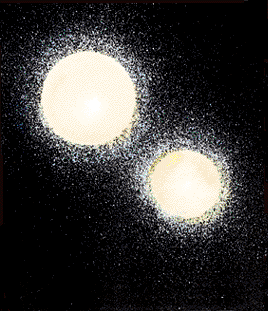 |
| The macabre Will-o-wisps from AD&D - The Balls of Steel - |
Until then,
Valete!
If
you liked this post, you may help me improve by sharing it in your
social networks. Also, if you are curious, give it a look
at my others works and
consider becoming my
patreon.
Subscribe to:
Posts (Atom)