

Showing posts with label Old School. Show all posts
Showing posts with label Old School. Show all posts
Sunday, June 7, 2015

Saturday, June 6, 2015

Friday, June 5, 2015
Deep Analysis: Rpg mechanics model and the Old School effective range
 |
| What is the logic behind rgp systems and Old School mechanics? |
Tuesday, June 2, 2015
Rpg Question – How can we handle Giant creatures in Old School?
 |
| A Hill Giant How the hell can a human fight it? |
The group
of adventures, after many days inside the gigantic dungeon, crawls
their way inside the monolithic cave of the ancient Red Dragon. With
a haunting presence the size of a tower, eyes glistening malignant
with fiery rage, its mouth oozing flames hotter than the sun, the
dragon smiles for the worthy opponents that rivals its magnificence.
Then, the brave warrior, with sword in hands, leads the charge
attack, screamming: “I attack the beast with all my might!”.
Monday, June 1, 2015
RPG Reflections - What makes an Old School System?

I've been
giving some thought about this simple, yet puzzling question. What
makes an Old School system feel like one? Or, in other words, what
are the components that, put together, create what 'feels like' an
old school game?
Saturday, August 16, 2014
OSR extras (2) - Marceline, the Vampire Queen of Adventure Time rpg character sheet

Following the recent announcements regarding Marceline and Princess Bubblegum, I decided to make a very special post to commemorate: an OSR monster entry for Marceline! The stats are compatible with Labyrinth Lord, AD&D and similars; and those in brackets are in ascendent values, compatible with Lamentations of the Flame Princess, Old Dragon and similars.
Marceline, the Vampire Queen of Ooo
HD: 13, or 66 hps, 106 in battle form
At: 11 [+9] , Battle Form 8 [+12]
Damage: 1 Bite 1d4; Battle Form 2 claws 2d6 e 1 bite 3d4.
AC: 0 [20], Battle Form -2 [22]
Sv: 3+
AL: Chaotic Neutral
AL: Chaotic Neutral
XP: 10.000
Special:

. Abominable Presence: Marceline is capable of changing her features to induce fear. All creatures with 4 HD or less are instantly paralysed. The others may make a saving throw or else be paralysed for 2d4 turns.

. Transformations: Marceline may shapeshift to innumerable different forms, normally with traces of bats, wolves and undead monsters. The GM must decide the capability of each new form she adopts - but, in general, she can take a Battle Form which have her size go from Medium to Huge, gain +40 hit points, +3 to Attak, +2 to AC and make 2 claw and 1 bite attack per turn.

. Resistances: Marceline has many untold resistances and defenses. One that is stated at the cartoon is her almost fire immunity (reduce all fire damage she receives by 100 points). As a Vampire, she must also have some immunities to enchantments and death spells. The GM is free to giver her specific resistances.

. Magical Instruments: Marceline owns a variety of different instruments whose special abilities are yet to be discovered. Many are able to play without an electric amplifier and it is known that her Axe Bass was used by her father as a weapon. The Ax Bass is, at least, a bass that can be used as a battle axe +3 that deals 2d10 damage per strike. The GM is free to give all her instruments new powers.
. Another Powers: With each episode, Marceline's power list grows. She is able to fly at will and with perfection. She has control over each and every strand of her gigantic flowing hair. She is able to drink the shades of red from people and objects (and, actually, that is what she needs to feed upon). She may also turn invisible wherever and however she wants - although that might not work in battle, by GM discretion. Anyway, the GM is free to create new power for the Vampire Queen.

. Weaknesses: Being a vampire, sunlight causes great damage to her. Every turn under sunlight, marceline loses 10% of her maximum HP undil destroyed at 0 hp. However, wearing long sleeved clothing and big (cowboy) hats are able to avert this nasty effect. But, worst than her weaknesses to the sun, Marceline is helpless against Ghosts. All her power won't work on them and she cannot hurt or defend against them. In fact, someone in Astral Form is capable to physically hurt Marceline, hiting her automatically and dealing 10 times the damage (so, 1d4 dagger would deal 10-40 damage to her).
Well, I hope you guys liked it. Marceline is my favorite character from Adventure Time, and I intend on speaking more about that series in the future (who knows, maybe even adapting it for OSR?).
Until then,
Valete!
Images 1, 2, 3, 4, 5, 6
Images 1, 2, 3, 4, 5, 6
If you liked this post, you may
help me improve by sharing it in your social networks. Also, if you
are curious, give it alook at my others works and consider becoming
my patreon.
Friday, August 15, 2014
Dark Souls rpg OSR (1) – The Basics: Souls, Humanity and Death
 |
Last time, I discussed what makes Dark Souls simliar to Old School rpg, and presente my idea of a Dark souls rpg project. So now, let's get started with it.
Adapting Dark Souls to a tabletop rpg is no easy endeavour, 'cause most of the game's experience comes from personal discovery and experimentation of each player, be it understanding the complex game mechanics, interpreting the game's story or dealing with bosses adn whatnots. Such individual experiences are not possible to be reproduced fully within a tabletop rpg, which is by design a social game. However, by the same token, there are experiences that the electronic game cannot simulate either, right?
Adapting Dark Souls to a tabletop rpg is no easy endeavour, 'cause most of the game's experience comes from personal discovery and experimentation of each player, be it understanding the complex game mechanics, interpreting the game's story or dealing with bosses adn whatnots. Such individual experiences are not possible to be reproduced fully within a tabletop rpg, which is by design a social game. However, by the same token, there are experiences that the electronic game cannot simulate either, right?
With that said, I'd like to point first and foremost that the objective here is translating the 'feel' of Dark Souls to the tabletop, together with the idea of its mechanics, like the engaging combat and mistifying story. So, with that out of the way, let's dive into the very basics of Dark Souls -> Souls, Humanity and Death.
Em Dark Souls, as criaturas têm almas – que, no jogo, é uma substância concreta e coletável a qual seria realmente o 'âmago' de um ser. Existem muitos tipos de almas no jogo, e parece que elas se arrumam em grandes grupos (almas de gigantes, almas de heróis renomados, almas de heróis desconhecidos etc.). No jogo, as almas são, ao mesmo tempo, tanto o 'gold' quanto o 'xp' do jogador – você as usa para aumentar de nível (melhorar seus atributos) e para comprar e aprimorar itens.
In Dark Souls, every creature (and even some unliving things too) have souls - which in the game is not only the 'heart' of a beings existance, but also a collectable, something that can be contained and used. In fact, souls are the main source of power - used to level up the stats of a character - but also the main currency there! We could believe that people use other kinds of trading resources in the world of Dark Souls but, in the game, we may only use souls.
In Dark Souls, every creature (and even some unliving things too) have souls - which in the game is not only the 'heart' of a beings existance, but also a collectable, something that can be contained and used. In fact, souls are the main source of power - used to level up the stats of a character - but also the main currency there! We could believe that people use other kinds of trading resources in the world of Dark Souls but, in the game, we may only use souls.
The curious with that mechanic of 'Gold as Xp' is very similar to the old D&D editions, where characters would gain 1xp for each gold piece they would hoard. Thus, that is completely appliable to the Dark Souls OSR I'm proposing - each XP a character gain may be used to level up or to 'buy' stuff. The character can store the souls inside him and just subtract them when needing to lvl up or buy an item. The thing is that the player will have to note on his sheet the 'XP total spent' in his character and the 'XP not used yet'. Also, the GM may accept other kinds of currencies in the game besides Souls - since the tabletop rpg may have some liberties beyond the electronic game.
Now, talking about Humanity, in Dark Souls there are a group of special souls: The Lord Souls, the souls which were taken by the Lords (or gods) to defeat the Ancient Dragons and create the Age of Fire. One of those Lords was, supposedly, the Pigmy - an ancestral of mankind - who would have shared his soul with all humanity. Therefore, the 'dark soul' would be the fragment the Pigmy gave to each human, and that is the Humanity score we see in Dark Souls.
In the tabletop rpg, Humanity would be a 7th atribute that the players would have to roll during character creation which would control a character's sanity and also the be amount of dark soul he has gathered. A Humanity score of 13-15 would give +5% XP by the end of the gaming session, 16-17 would give 10 and 18+ would give 15%. However, having high humanity is a risk, for many creatures lust to devour those souls. Therefore, the same bonus should be applied to the random encounter chance of the adventurer party, making it easir for monsters to attack them (e that percentage is cummulative with each and every member! The Dark Souls world is indeed a dangerous one!).
Humanity is crucial because of its connection with Death. In Dark Souls, all characters are Undead, people cursed with never dieing. When an Undead is killed, his body disintegrates, together with his items, and he will be reborn in 1d4 hours at the last bonfire that he've been. In the game it is said that, with each passing hour and with each extra death, an Undead has its humanity lost and, together with it, also its memmories, reason and emotions. Thus, every time a character is killed, he loses 1d6 Humanity. The lower his humanity goes, the more zombified and irrational he becomes. With 8 Humanity, his senses are blurring and he oft loses his train of though. With Humanity 3, he is ravening maniac, but still has a grasp with reality. If a character goes to Humanity 0, or dies without his soul ever being connected to any bonfire, he becomes a Hollow. He is reborn at the same place he died as a complete ferocious and animalike zombie. If he is killed at this state, his equipment may be stolen before disintegrated and will not go back to him.
In order for a character to gain Humanity, he may find it in soul fragments found in monsters, which is a very rare occurrence. With every encounter with monsters, the Gm may roll a 1d100. If it is 100, there was 1 humanity and the GM may roll again, and, for every 100 rolled, there was another 1 humanity. The best way to gain humanity is killing humans with high Humanity. Someone with 13 to 15 humanity gives 1 humanity, 16-17 gives 2 and 18+ gives 3 to their killer.
And thus we end the first part of this fan project for Dark Souls old school tabletop rpg. Next time I will talk about the character classes that can be used and I will introduce a new one with very special mechanics - The Chosen Undead class.
Until then,
Valete!
And thus we end the first part of this fan project for Dark Souls old school tabletop rpg. Next time I will talk about the character classes that can be used and I will introduce a new one with very special mechanics - The Chosen Undead class.
Until then,
Valete!
If you liked this post, you may
help me improve by sharing it in your social networks. Also, if you
are curious, give it a
look at my others works and consider becoming
my patreon.
Thursday, August 14, 2014
OSR extras (1) - Pentakill's Lightbringer, an artifact for tabletop rpg
 | |
|
So, I was hearing an amazing music, The Lighbringer, by Pentakill, and inspired by it I decided to write something Old School out of those lyrics. Thus, t'is a special post for League of legends players, music lovers and old schoolers. I bring thee 'The Lightbringer', an artifact for old school tabletop rpg.
 |
| Icon of the item in LoL |
It is one of the most powerful relics from the distant plane of the 'Legends of Leagues'. Any person can feel its magical aura, be that person trainned in the arcane arts or not. As a weapon, the Lightbringer works as a short bow +3 of returning - its arrow always coming back after you fire it. In fact, even if the arrow has not yet struck the opponent, the user may continue attacking - if he has more than one attack per turn - and new replicates will magically appear, allowing him do to so. The bow also does a critical hit (doubling the damage) on a 16+ natural on the d20, and the hurt creature will bleed for three turns, losing extra 1d6 hp per turn. At last, those who have the bow in their posession (either at hands or just carrying it on their back) are capable of perceiving ambushes (they cannot be surprised) and sense invisible creatures as if they had True Sight.
With this set of skills, the Lightbringer is already a powerful magical item. However, there is more. If the user is of lawful alignment and has come into contact with the legendary and lost song of the bardic band Pentakill, he may rise the weapon to the sky and scream 'I am the Lightbringer'. If he does so while wishing to give up his soul to fighting the darkness of the world, he will then become the Champion of Light - his souls forever bounded into combating the shadows, evil and chaos. With that, when using the Lightbringer, the relic shows its true power.
Now, besides all those other powers, it is a +3 bow that becomes +6 against chatoic or evil creatures. Everytime it gets a critical hit against such creatures, they must succeed in a saving throw against magic or be desintegrated. Besides that, the Lightbringer may change to fit its user will, with its part componentes becoming any suitable weapon - for example, it could become a whip because of the bow's string; the arrow's head may get thinner and become a sword; the shaft may be used as a club etc. No matter the form, it will maintain the 'returning' enchantment - so, even if you throw it as a hammer or sword, it will go back to the user's hand. If surrounded by enemies, the user may scream 'Bring Down the Reckoning' to explode in light, causing his melee damage to all creatures in a 30 feet (50 meters) radius around him. The creatures can make a saving throw to take half damage. This attack is hurtful even for the user and his allies, which receive the damage too. At last but not least, the user presence becomes inspiring, giving +1 Moral to troops and allies e, as long as his soul belongs to the Lightbringer, he will not get old.
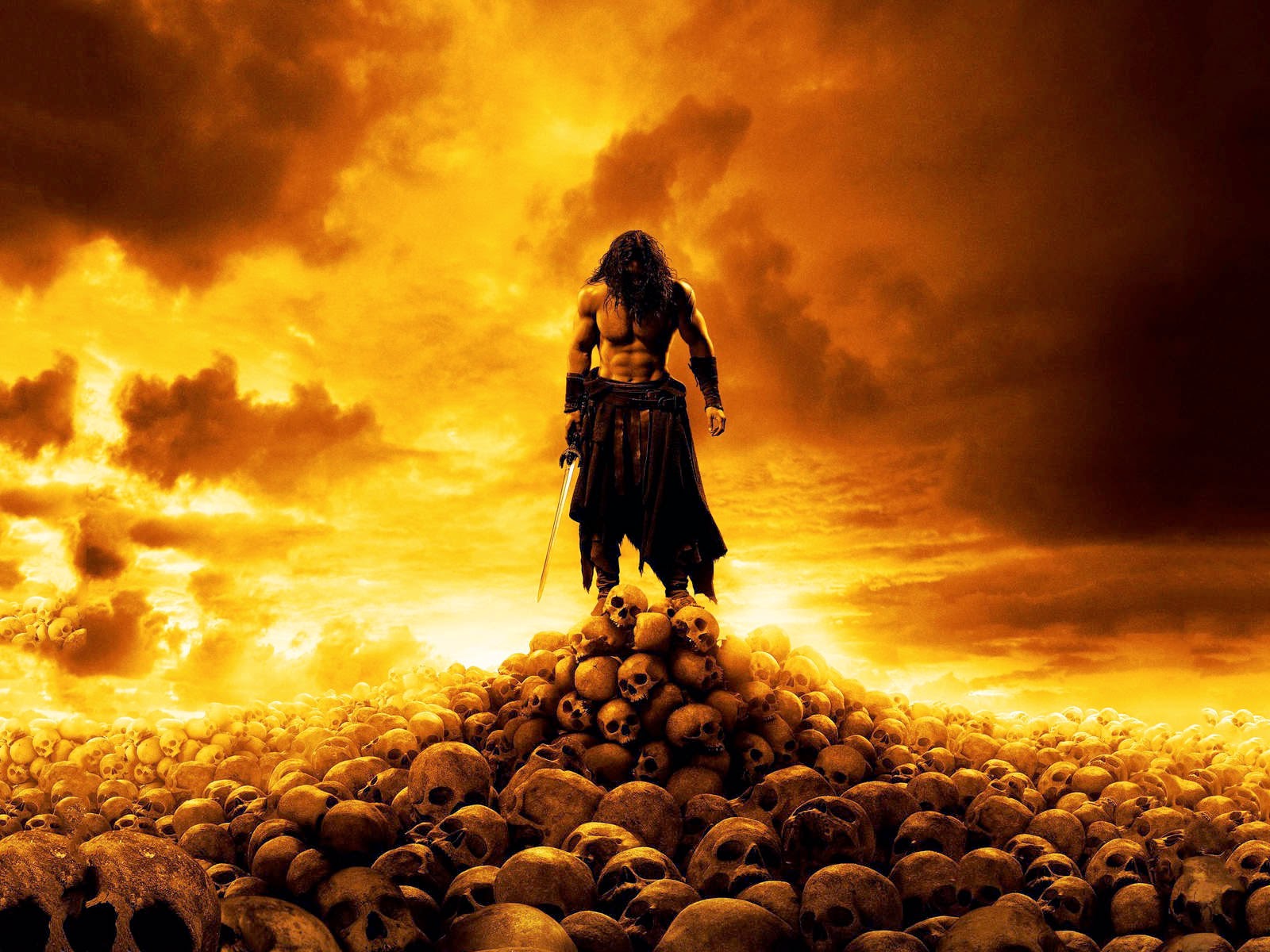 |
| Never surrender, never retreat, until the Light embraces all - or until the Light of your eyes is lost - |
But such power comes with a bitter price. The user is transformed, becoming a vengeful person, obsessed with 'bringing back' the 'golden age', saving the 'kingdom', 'bring down the dark regime' and other criptic sayings that not even he knows what they mean. He will fight every day, never truly resting, always in a state of complete dedication and abandoned recklesness. He must fulfill his destiny and fight the shadows off this world and lead everyone to victory. Such a powerful blessing and curse are impossible to be dispelled even by the gods - only the Wish spell may have any chance of freeing the user from the Lightbringer and, even after that, the user will forever feel 'empty', as part of the light that illuminated him was lost.
If the user dies while embodying The Lightbringer, the relic will find someone else to wield it. It is said that no shadow can hold it for long and, in one way or another, the weapon will always end up in the hand of a good warrior. And if that warrior happens to discover the legendary song of the Pentakill, then he may also become, again, The Lightbringer embodied.
So, what do you guys thing of my adaptation? I centered it around the epicness of the Pentakill's song, and I hope you liked it.
Until next time,
Valete
So, what do you guys thing of my adaptation? I centered it around the epicness of the Pentakill's song, and I hope you liked it.
Until next time,
Valete
Ps: Yeah, the Lightbringer is a League of Legends item from Dominion map. Didn't you also think just like myself that it was a reference to Lux, eh?
Images 1 , 2, 3
- Extra: The Lyrics of the music -
Fellow armsmen, I ask you,
Will you follow me tonight to break their spine,
And reclaim what once was mine?
Those cravens.
Backstabbed me, deceived me,
Images 1 , 2, 3
- Extra: The Lyrics of the music -
Fellow armsmen, I ask you,
Will you follow me tonight to break their spine,
And reclaim what once was mine?
Those cravens.
Backstabbed me, deceived me,
Never shall I tolerate their crimes again,
Now let the hunt begin.
Now let the hunt begin.
7000 souls, scared and daunted, such tale of woe,
Not too long ago, this village was a golden
scene of hope.
To bring back hope and peace,
Restore our gloria,
To live forever.
Bring down the dark regime,
Lead us to order,
I am the Lightbringer!
Fellow warriors, I ask you,
Should my campaign come to an end?
There's way more to avenge.
Should my campaign come to an end?
There's way more to avenge.
15 million souls,
Not too long ago, this kingdom was a golden
state of hope.
If you liked this post, you may
help me improve by sharing it in your social networks. Also, if you
are curious, give it a
look at my others works and consider becoming
my patreon.
Wednesday, August 13, 2014
Reflections - Dark Souls and the Old School tabletop rpgs
 |
| Light and Darkness, Life and Death - Dark Souls and the Old School - |
I've been pondering the idea of adapting the Dark Souls game to tabletop rpg; specifically, an old school system tabletop rpg. Why? Because I believe that both the Old School rpgs and Dark souls have a lot in common.
Allow me to ellaborate while talking about Dark Souls. That is an electronic rpg where the player controls an Undead, a person cursed with never being able to truly die. Every time its body is destroyed, the Undead go back to life, and with each death a part of its soul and humanity are lost until eventually it becomes a Hollow - basically, a zombie. Dark Souls have been gaining a considerable amount of fame for its great and detailled setting, its complex storytelling, its amazing combat system and its obscenely high difficulty.
Talking first about the setting, I'd like to point out that the aesthetics of the game are one of a kind - not necessarily for its technological achievement, which, by itself, is indeed great, but by the design choices. Each ambiance, piece of clothing, rock, blade of grass seem to be chose deliberately - the details with the creation behind the game's design, revealed by the design team, is impressive, all focusing on a concept of 'noble decadence' headed by its director, Miyazaki.
The story in Dark Souls is told in a different way than most games. While normally the story is spoonfed to the players with blatant plot expositions, in Dark Souls it is very minimalistic, told mostly through the items descriptions the player may find during the game. Because of that, many believed, for a while, that Dark Souls had no story, because the main NPCs tell very little about it. To understand truly (or at least try to understand) what happens in Dark Souls, a player must collect many different items and cross-reference them, trying to find themes similar between them all. It's a very open endend story, where the player must build, block by block, from their own creativity.
Combat in Dark Souls is, to me, one of the greatest fighting mechanics to greet the electronic gaming market in the last years. It does not try to emulate over the top anime and superhero action. Very 'realistic', very 'down to earth', combat in Dark Souls has more plausible moves from the character. And, even if you get really strong and powerful, you still have to take care of yourself. Even the weakest enemies can kill a player that is unaware. And every single enemy has its own advantages, disadvantages and tatctics to be dealt with. If you do not know them and either overestimate your skills, or underestimate your opponent, you will die.
 |
| - Dark Souls Mimic - |
Death. That is one of the main topics to experience Dark Souls. In truth, the game is made so that death may teach the players the limits of their characters. Many times it even seems that the game is being sadistic, with traps created specially to kill the characters and enfuriate the players - like the Mimic, a monster that seems just like a treasure chest and that can devour a character with one motion of its gigantic mouth. That is made with purpose. Those traps exist to make the player always prepared, knowing that the world is aware of him and ready to kill him. Death makes the world of Dark Souls real and rises the level of dedication and investment from the players.
To me, all of those aspects create a direct connection between Dark Souls and the Old School tabletop rpgs. In the Old School, settings would usually focus in various minimal details, like clothing, sizes for corridors and texture of rocks - and such details were casually applied to the old school storytelling experience too. Combat in Old School used to have the players really be at their feet, for many of the creatures would kill them easily with instant-death attacks (the infamous 'save or die' aspect of Old School), requiring that the players knew when to fight and when to run. Many modern rpgs have very pondered and balanced encounters with monsters, having no room for the unpredictability of sudden death to strike down upon a character's flesh.
To me, all of those aspects create a direct connection between Dark Souls and the Old School tabletop rpgs. In the Old School, settings would usually focus in various minimal details, like clothing, sizes for corridors and texture of rocks - and such details were casually applied to the old school storytelling experience too. Combat in Old School used to have the players really be at their feet, for many of the creatures would kill them easily with instant-death attacks (the infamous 'save or die' aspect of Old School), requiring that the players knew when to fight and when to run. Many modern rpgs have very pondered and balanced encounters with monsters, having no room for the unpredictability of sudden death to strike down upon a character's flesh.
 |
| Incredible vistas and effemeral existances - The aesthetics of 'Noble Decadence' - |
But that is the great unifying point between Dark Souls and Old School - the verossimilitude that exists in the fictional world and the players attention through the death of their characters. It is the character's mortality that seems to breath life into the story. In Old School, the rules of the game were final, in the same way that, in Dark Souls, when a monster stomp you to death, you just accept it. The unbending rules of the game gave a distinct outline and breadth to the stories created by them, in the same way as the immense difficulty inside the Dark Souls game gives that strange feeling of 'reality', where the players really feel like achieving something when they finally defeat a big boss or finish the game.
And that is why I think Dark Souls and Old School tabletop rpg are similar with one another. Next time, I will start discussing how to adapt Dark Souls to a tabletop rpg format.
Until then
Valete!
Images 1 , 2, 3
If you liked this post, you may
help me improve by sharing it in your social networks. Also, if you
are curious, give it a
look at my others works and consider becoming
my patreon.
Tuesday, August 12, 2014
Brazillian rpgs - Old Dragon and the brazillian Old School Renaissance
 |
| Old Dragon - the Old School Renaissance in Brazil - |
I have already said a little bit about brazillian rpgs, like 3d&t, Daemon and Tagmar. Now I would like to talk about the Old School Renaissance (OSR) in Brazil, using its foremost examplar: the Old Dragon system.
Just like what happens with other OSR rpgs, the Old Dragon (OD) has its rules based in old D&D editions - however, while some may try to follow closely those editions, OD gathered many different concepts and created a new arrangement, although still being compatible with other Old School materials.
Da 1a Edição de D&d, OD usa as jogadas simplificadas de salvamento, tendo apenas uma jogada de proteção. Além isso, usa o mesmo sistema de tendências, possuindo apenas Ordem, Neutralidade e Caos. Com relação às classes, OD usa a base da 2a Edição de D&D, onde as raças se diferenciam das classes e não existe uma lista de talentos nem de perícias – os poderes especiais são ganhos a partir do avanço em níveis de uma classe específica. Com relação aos atributos, seus modificadores seguem o padrão da 3a edição de D&D (12 = +1; 16 = +3; 20 = +5; 30 = +10 etc) e, no geral, os valores estatísticos são semelhantes à 3a edição. Assim, de maneira geral, OD usa estatísticas da 3a edição, usando as mecânicas de resolução da 2a edição e com alguns toques pontuais da 1a edição.
From D&D 1st edition, OD uses simplified saving throws (having only a single score) and its allignment system of Order, Neutrality and Chaos. Regarding classes and races, it follows 2nd edition D&D, where races and classes are sepparated. Besides, they have no focus on feats and skills like third edition, and each class has abilities similar to those of AD&D. Finally, regarding overall statistics, they are very similar to 3rd edition - they use ascending attack rolls and Armor Class and its attribute modifiers are the same as 3rd edition (10 = +0, 20 = +5, 30 = +10, 40 = +15). In resume, generally speaking, OD uses therefore 3rd edition's stats with 2nd's edition mechanic resolution with a few touches from 1st edition.
From D&D 1st edition, OD uses simplified saving throws (having only a single score) and its allignment system of Order, Neutrality and Chaos. Regarding classes and races, it follows 2nd edition D&D, where races and classes are sepparated. Besides, they have no focus on feats and skills like third edition, and each class has abilities similar to those of AD&D. Finally, regarding overall statistics, they are very similar to 3rd edition - they use ascending attack rolls and Armor Class and its attribute modifiers are the same as 3rd edition (10 = +0, 20 = +5, 30 = +10, 40 = +15). In resume, generally speaking, OD uses therefore 3rd edition's stats with 2nd's edition mechanic resolution with a few touches from 1st edition.
Despite being relatively new (not even 5 years in market yet), OD has a very active rpg community in Brazil, with both old and new players that are always creating new supplements, rules and adventures for the game. OD, being of yet the only OSR published in Brazil, has been contributing a lot so that the the Old School trend continues strong in Brazil.
 |
| - Old Dragon with its outstanding illustrations- |
Espero que tenham gostado dessa pequena apresentação do Old Dragon e do Old School no Brasil. Pretendo logo estar postando sobre adaptações de lendas brasileiras para serem usadas com regras Old School, de modo a contribuir para os Gms de todo mundo que tenham interesse em usá-las nas suas aventuras e campanhas.
I hope you enjoyed this short presentation of Old Dragon and OSR in Brazil. I have plans to post some adaptations of brazillian legends and creatures to be used in Old School rpgs, so GMs over the world that are interested in such topics may use them in their adventures.
Until then, tell me what you think about Old Dragon,
Valete!
I hope you enjoyed this short presentation of Old Dragon and OSR in Brazil. I have plans to post some adaptations of brazillian legends and creatures to be used in Old School rpgs, so GMs over the world that are interested in such topics may use them in their adventures.
Until then, tell me what you think about Old Dragon,
Valete!
RPGaDay, old rpg you still read/play - Daemon and AD&D
 |
| Old rpgs I still read, Daemon and AD&D - in the background, Septimus Malleus - |
Hoje, seguindo o #RPGaDay, falarei sobre o rpg antigo que eu ainda jogue/leia. Para os leitores desse site, não será uma surpresa ao dizer que eu ainda leio os antigos livros de AD&D. Portanto, para ir além do óbvio, irei falar de outro rpg antigo que eu ainda leio: O Daemon.
Today, following the #RPGaDay, I will talk about an old rpg that I still read/play. For those following this blog, it will be no surprise that I say I still read the old AD&D books. Because of that, going beyond the obvious, I will talk about another rpg I still read: Daemon.
Today, following the #RPGaDay, I will talk about an old rpg that I still read/play. For those following this blog, it will be no surprise that I say I still read the old AD&D books. Because of that, going beyond the obvious, I will talk about another rpg I still read: Daemon.
As I said before, Daemon is, to me, one of the foundation stones of Brazillian rpg (together with 3d& and Tagmar), and would be the brazillian equivalent to 'Gurps' or 'Call of Cthulhu'. It has, for me, the best attribute progression in any rpg, using a mathematical formula which, for evey 6 points, you double the effect of the attribute. Besides that, the system has one of the best fluff for magic system - since the book author, Marcelo del Debbio, is himself an occultist and the magical practices inside the book reflect, at least to my knowledge, directly his magical studies.
 |
| Arkanum, the classic setting of Daemon - Medieval inquisition with cruel angels and ambitious demons - |
Contudo, Daemon é envolto em infâmia e, hoje, muito mal visto por todos que ainda não o joguem. A maioria de seus livros consiste de cópias de texto uns dos outros. Suas regras costumam ser, muitas vezes, mal explicadas ou com a sensação de 'inacabadas'. Sua progressão matemática de 'a cada 6, dobre o efeito' não consegue ser aplicada de maneira efetiva às rolagens do sistema, e mesmo o sistema de magia, que é extremamente bem feito teoricamente, na parte mecânica do sistema é bastante simples e não passa de um sistema comum de 'pontos de magia'.
However, Daemon is shrouded in infamy and, today, kind of hated by all who do not play it. Most of its books have copies from texts from each other. Its rules are, many times, not explained well or have the sensation of 'undone'. Its mathematical progression of 'every 6 units double the effect' does not apply itself effectively to the rolls of the dice, and even its magic system, which is outstandingly well done fluff-wise, mechanically is very weak with simple 'magic points' applications.
Nevertheless, it is a very important rpg for me. Its aspect of 'undoneness' makes Daemon have an aura similar to that of old D&D, where GMs had to improvise rules. In the same way, one of the greatest Old Schools communities in brazillian tabletop rpgs is the one from Daemon, creating new rules even today, and even after a decade that the game has been 'dead'.
Well, but I will talk more about Daemon in another time. But how about you, folks, what old rpg do you still play/read?
Until then,
Valete!
Saturday, August 9, 2014
Discussing D&D (3) – Alignments are not choices
 |
| You may hide the colors of your soul from others, but not from yourself - Alignments are not a choice - |
I see many a discussion surrounding alingments in D&D, specially on how they are confusing and hard to understand. I imagine that the origin of such confusion derives from the way that people face alignment in D&D, which is in the same way as we face how people act in the real world.
In our world, people are not born 'evil' or 'chaotic' or 'neutral' - unless, maybe, in extreme situations conditioned by genetical or sociological problems. The way we act comes from our experiences with the world, how we were raised, how much happiness or suffering we endure during our life. Therefore, in our world, the way someone is comes from how that person experiences life and the choices she makes.
 |
| Alignments would be conected to the colors of the soul and the energies of the body |
However, would that be the same way in D&D? To comprehend better, maybe we should try going back to the origins of D&D, its inspirations on fantastical litterature, like for example the works of Tolkien. In The Lord of the Rings, 'Good' and 'Evil' are opposing forces, and people seem to have those attributes inside their very soul.
And we see a similar thing happening also in D&D with, for example, the planes of 'Law', 'Chaos', 'Good', 'Evil', where alignments are just as real as the air we breath. Therefore, we may conclude that, in D&D, alignments are Cosmic Energies, components of the very fabric of the multiverse.
And it happens so that even innanimate objects, which in no way could have beliefs or creeds, may also have something similar to 'tendencies'. For example, there are items which were used for evil acts and that become 'evil' magic items; and the same may happen with an object used for great and good deeds. By the same token, a place that witnessed many evil doings - like, for example, an execution chamber - may have an 'evil aura' surrounding it. This only reinforces my assertion that tendencies are elements that compose the universe in D&D, and, by logic, they also compose the characters too.
And, because I see tendencies as cosmic energies, that's why I think I never had any problem with them in D&D. To me, tendencies are not a matter of choice - you are born with them. Like in the real world, where we cannot chose to be born ugly or beautiful, rich or poor, with a masculine or feminine sex, liking X, Y or Z. That is why changing alignments is so traumatic, hard and, most of the times, impossible for a character. They represent the cosmic energies that flow inside you - lawful, evil, good, chaotic. Only in extreme cases (like great suffereing, extreme effort, magic or divine intervention) one would be able to change alignments - in the same way that, in our world, we cannot just change, by our own free will, our biological sex.
 |
| Alignments in the world of D&D compose the fabric of the universe and the spirit of a character |
So, that is my opinion regarding alignments. They are ingrainned with the character and is not just a body of beliefs or creeds that he has. But, what about you? What do you think about thsi post? What are your opinions regarding all of that? In another post, I intend on talking about the alignment chart and what I think about each type.
Until then,
Valete!
If
you liked this post, you may help me improve by sharing it in your
social networks. Also, if you are curious, give it a
look at my others works and consider becoming
my patreon.
Wednesday, August 6, 2014
The Aftermath! Talking with the readers (1) – What did people say about Hit Points?
 |
| 'Luce sunt clariora tua consilia omnia'- 'All your advices are clearer than light' Cicero, great orator from ancient Rome |
(Summary TL;DR)
. This is the
Aftermath of the comments and discussion surrounding Hit Points in
D&D by the readers.
. The main points
discussed were: 1,) Hit
Points are more than just 'Toughness'; 2,) Hit
Points do not represent wound level or actual structural damag; 3,)
How to interpret and describe Hit Points in the game;
4,) . How to deal with
the 'Dagger to the throat' situation; 5,)
How do other systems
deal with Hit Points.
><><
One
of the objectives of this blog is to talk about games, have people
come, give their opinion and join others in discussion. With that
said, I have to say that I was indeed surprised by how many of you
engaged in discussion on the subject of Hit Points in my other post.
The discussion was spread out through
many groups in facebook - Tabletop Role-Playing Games,
Old school TSR gamers, Old School Roleplaying,
YouTube RPG Brigade,
Dungeons and Dragons (AD&D 2nd Edition)
and Old School Gamers – and
now it is time for the 'Aftermath!', where we try to summarize what
was said in all those comments:
-
Main points discussed -
.
Hit Points are more than just 'Toughness': This
was a subject that I believe everyone agreed on. HP, just like how in
D&D it is normally accepted nowadays, represent also 'magic',
'luck', 'dodge', 'stamina', 'fatigue' and other abstract ideas
instead of only 'physical resistance'.
.
Hit Points do not represent wound level or actual structural damage:
Many have touched upon that subject, with HP being just a mechanical
abstraction to make combat easy to deal with. Therefore, they do not
represent how battered a combatant is – or, at least, not with
great mechanical influence, like the Bloodied rule (less than 25%
HP), which does not have too great of an impact despite triggering
special abilities to occur. But many readers suggested different
rules for modifiers regarding how many Hps you have left.
.
How to interpret and describe Hit Points in the game: One
of the main problems concerning HP was 'how should a GM or player
narrate the effect of damage?'. What most people said was that one
should see how much 'percent' of their main HP was taken by the
successful attack. So, if you lose just around 1-5% (1-5 HP in 100
total), that would mean an evasion, dodge or glancing blow. 10-25%
would mean a hit, although not a strong one. Something more than that
would mean a very powerful hit. Also, narrating finishing blows
(where you say that you kill your enemy) would only be allowed when
the player (or monster) died by the attack.
.
How to deal with the 'Dagger to the throat' situation:
In old school D&D, there were no hard rules telling how to deal
with it, and common sense should apply. In new editions, there was
the rule for 'coup de grace', that could kill a combatant in one
single blow. What most people agreed upon is that, if a situation
proved to be lethal, either the character would die or he would have
to make a saving throw (Fortitude, Poison/Death or similar) to avoid
death.
.
How other systems deal with Hit Points:
One subject that was agreed upon was that D&D combat simulates
'heroic' and 'cinematografic' fighting; therefore, the HP did not
reflect how tiring damage can be to one's body. Many different
systems were quoted in order to present different ways on how to deal
with HP. Two of the most quoted were Savage Worlds, another system
for fantastic and action oriented combat which uses something similar
to AC in D&D but, instead of Hit Points, you would have like
'Woud Levels'; and the Storyteller system, which uses a much more
concise and realistic representation of Hit Points with also the
Wound Leves of a character and how the level of hurt can interfere in
one's action.
- Comments by the
Readers -
Now, I would like to
show just a few of the comments to illustrate the main topics
discussed:
 |
| - Reading attentively comments - |
. Loke VP: “The whole HP-as-luck thing seems to make it be a form of AC. Frankly, I'm a bit confused as how to tell it to players. "The orc misses, you lose 12 HP"”
This
comment raises the question on how to narrate the outcome of damage
in D&D. I replied to Loke some ways that you could do so: a)
HP
as luck: "Even
though that was a sure hit, the blow just, by sheer luck, hit the
air"; b)
HP as stamina:
"The blow hits you directly, but you were able to withstand it";
c)
HP as evasion:
"the attack was just a glancing hit, causing only a few
scratches"; d)
HP as magic:
"The attack hits you, but causes no real damage"; e)
HP as sheer toughness: "The
sword gnashed through your arm, but you just laugh and continue
fighting". In my games, most of the time I consider that
the characters are magically empowered and HP is just supernatural
density/resistance. Like in action movies (where the guy is shot
multiple times and still goes on) or anime or epic heroic saga (in
the same way how Achilles was able to stand strong against hundreds
of soldiers during the War of Troy).
. Eric V: “Not to be glib, but it represents not being dead. It's
intentionally abstract, and that's to the benefit of the game. D&D
doesn't address the pain of injury, just a binary state of OK and NOT
OK”
For
me, this comment summarizes most of the discussion. HP is mostly
that: the binary state of OK and NOT OK. Perfect definition and very
direct to the point.
. Mel T:
“I
worked at a bar many years a go one night one of the bouncers got his
throat slashed with a broken bottle,he came to work the next day.
just cause you got cut does not make it critical”
Folks,
that's is real life being just like D&D. Deal with it, ha! But in
all seriousness, I love this comment and it goes to tell how strange
life can be sometimes, even stranger than fiction. Amazing.
. Melanie M.:“One
of my DMs use movies as a comparison. Any hit that does not put you
in your bleed is "but a scratch". Its that last hit with
the sword that finally managed to find a kidney. So at 1 hp out of 70
you're out of breath, covered in little nicks everywhere and feeling
battered. But you are not going to be falling apart until a stiff
breeze of 2 dmg hits you. And falling on your butt unconscious after
winning a fight is the diehard feat catching up with you (re:
fighting in neg hps)”
One
of the many comments regarding how to handle HP in the world game. I
found it very good.
.
Vaughan C.:
“The
abstracting of skill in defense and other factors such as fatigue
into Hit Points works reasonably well until you reach the healing
issue. Why does it take so long for a skilled combatant to recover
his ability to defend himself and his energy levels? Far longer than
a beginning fighter. Plus why is the magical recovery of such
potential called "Cure X Wounds" and use the same spell to
recover as does the actual knitting together of damaged flesh?”
This
very good comment raises the interesting point of 'how to interpret
the healing issue' in D&D. That is enough for a whole new topic,
and I will save it for another post. However, I would like to say, in
regards to the 'paradox of fighters healing less', I would say that
the 'Heal speals' would also heal the 'magic and luck aura' that
surrounds a character. Therefore, it would need more 'magical energy'
to heal someone like a warrior, with much more HP than a mage, for
example.
.
Dennis B. L.:
“I
find it easier if you dont view hit points as points of damage but
rather combat fatigue/stress/expertise. When you run out that´s
when the potential killing blow will come. Yes it doesn´t make
sense in some situations but then IMO hit points only make sense if
they dont increase dramatically as in D20.The bloodied rule (under
25% hit points) is strange to me as that´s when you start to
hurt but no penalties”
A
comment regarding the no mechanical effect regarding loss of HP in
the game.
.
Steve O.:
“There
is a danger that called shots and vorpal swords can ruin a game. I
think that if there is a possibility that someone can chop off your
hand, there should also be a spell that "unchops" your
hand. And do you really want to open the door to throat slashing?
With these realistic concepts in a fantasy game, you are risking
ruining the mechanics of the game (although I applaud some of the
"fixes" listed above). By opening this door, you are
opening a Pandora”
Yes, trying to
equilibrate realism with fantasy is a very hard task, indeed. And I
have to say, I love Pandora's legend. One day I must talk about her
here in the blog.
.
Nathan F.:
“
I agree 100% with your read. This conceit is at work I think in
Stephen Donaldson's Mordant's Need. In fact one character (who is
clearly a fairly high level fighter) does a cliff-jump pursuit much
as you describe.
It's
not explicit, but I thought of it immediately when you described your
bandit pursuit scenario, and the leaper is Castellan Lebbick (a
character who reminds me very much of Javert, from Les Miserables).
Lemme see if I can dig up an excerpt. Pretty sure it's book 2 (it's a
two book series)”
I
was extremely surprised that my example of the 'warrior jumping off a
cliff' had happened in a literary source. Very interesting!
.
Jeff S.:
“There
are systems where parts of the body are assigned individual points,
or a good hit can kill regardless of hit points. Rolemaster comes to
mind, also Cyberpunk. In RuneQuest you never gain hit points - you
just get harder to hit. It's more realistic as even a simple trap can
kill you outright, but you may go through a lot of characters. In
Palladium, both you and your armor have hit points. I recall Gary
Gygax writing about the hit point system, but I can't recall where.
He described hit points as part physical and
partly an expression of a character's luck or skill in avoiding
damage. So what seems like a massive hit can actually be seen as a
loss of luck. Some systems use Edge points to simulate luck, but Gary
rolled it all up into hit points and left it simple. Wasn't it he who
said that the big secret of D&D was that nobody actually needed
any rules?”
That
is a very good quote to remember from Gary Gigax, with his thoughts
in regard to HP.
><><
And
that's it, folks. This is the Aftermath of our discussions
surrounding HP, and I hope we continue having more like this. I would
also like to ask you all to also discussing here in the blog, so we
could have all talking happening in one place instead of having it
scattered through many different groups. There were very good
arguments said by different people in different places, and it would
be awesome if they could all share their thoughts together.
Next
time, I would like to talk about another interesting topic, although
not much debated, surrounding D&D: Initiative and Declaration of
Intents and Actions.
Until
then,
Valete!
Subscribe to:
Comments (Atom)