 |
| So, there is a new souls game. Except that now, it is not about souls. It is about blood. |

Showing posts with label D&D. Show all posts
Showing posts with label D&D. Show all posts
Monday, June 8, 2015
The Hunter from Bloodborne: new class for Old School D&D

Sunday, June 7, 2015

Saturday, June 6, 2015

Saturday, August 16, 2014
OSR extras (2) - Marceline, the Vampire Queen of Adventure Time rpg character sheet

Following the recent announcements regarding Marceline and Princess Bubblegum, I decided to make a very special post to commemorate: an OSR monster entry for Marceline! The stats are compatible with Labyrinth Lord, AD&D and similars; and those in brackets are in ascendent values, compatible with Lamentations of the Flame Princess, Old Dragon and similars.
Marceline, the Vampire Queen of Ooo
HD: 13, or 66 hps, 106 in battle form
At: 11 [+9] , Battle Form 8 [+12]
Damage: 1 Bite 1d4; Battle Form 2 claws 2d6 e 1 bite 3d4.
AC: 0 [20], Battle Form -2 [22]
Sv: 3+
AL: Chaotic Neutral
AL: Chaotic Neutral
XP: 10.000
Special:

. Abominable Presence: Marceline is capable of changing her features to induce fear. All creatures with 4 HD or less are instantly paralysed. The others may make a saving throw or else be paralysed for 2d4 turns.

. Transformations: Marceline may shapeshift to innumerable different forms, normally with traces of bats, wolves and undead monsters. The GM must decide the capability of each new form she adopts - but, in general, she can take a Battle Form which have her size go from Medium to Huge, gain +40 hit points, +3 to Attak, +2 to AC and make 2 claw and 1 bite attack per turn.

. Resistances: Marceline has many untold resistances and defenses. One that is stated at the cartoon is her almost fire immunity (reduce all fire damage she receives by 100 points). As a Vampire, she must also have some immunities to enchantments and death spells. The GM is free to giver her specific resistances.

. Magical Instruments: Marceline owns a variety of different instruments whose special abilities are yet to be discovered. Many are able to play without an electric amplifier and it is known that her Axe Bass was used by her father as a weapon. The Ax Bass is, at least, a bass that can be used as a battle axe +3 that deals 2d10 damage per strike. The GM is free to give all her instruments new powers.
. Another Powers: With each episode, Marceline's power list grows. She is able to fly at will and with perfection. She has control over each and every strand of her gigantic flowing hair. She is able to drink the shades of red from people and objects (and, actually, that is what she needs to feed upon). She may also turn invisible wherever and however she wants - although that might not work in battle, by GM discretion. Anyway, the GM is free to create new power for the Vampire Queen.

. Weaknesses: Being a vampire, sunlight causes great damage to her. Every turn under sunlight, marceline loses 10% of her maximum HP undil destroyed at 0 hp. However, wearing long sleeved clothing and big (cowboy) hats are able to avert this nasty effect. But, worst than her weaknesses to the sun, Marceline is helpless against Ghosts. All her power won't work on them and she cannot hurt or defend against them. In fact, someone in Astral Form is capable to physically hurt Marceline, hiting her automatically and dealing 10 times the damage (so, 1d4 dagger would deal 10-40 damage to her).
Well, I hope you guys liked it. Marceline is my favorite character from Adventure Time, and I intend on speaking more about that series in the future (who knows, maybe even adapting it for OSR?).
Until then,
Valete!
Images 1, 2, 3, 4, 5, 6
Images 1, 2, 3, 4, 5, 6
If you liked this post, you may
help me improve by sharing it in your social networks. Also, if you
are curious, give it alook at my others works and consider becoming
my patreon.
Friday, August 15, 2014
Dark Souls rpg OSR (1) – The Basics: Souls, Humanity and Death
 |
Last time, I discussed what makes Dark Souls simliar to Old School rpg, and presente my idea of a Dark souls rpg project. So now, let's get started with it.
Adapting Dark Souls to a tabletop rpg is no easy endeavour, 'cause most of the game's experience comes from personal discovery and experimentation of each player, be it understanding the complex game mechanics, interpreting the game's story or dealing with bosses adn whatnots. Such individual experiences are not possible to be reproduced fully within a tabletop rpg, which is by design a social game. However, by the same token, there are experiences that the electronic game cannot simulate either, right?
Adapting Dark Souls to a tabletop rpg is no easy endeavour, 'cause most of the game's experience comes from personal discovery and experimentation of each player, be it understanding the complex game mechanics, interpreting the game's story or dealing with bosses adn whatnots. Such individual experiences are not possible to be reproduced fully within a tabletop rpg, which is by design a social game. However, by the same token, there are experiences that the electronic game cannot simulate either, right?
With that said, I'd like to point first and foremost that the objective here is translating the 'feel' of Dark Souls to the tabletop, together with the idea of its mechanics, like the engaging combat and mistifying story. So, with that out of the way, let's dive into the very basics of Dark Souls -> Souls, Humanity and Death.
Em Dark Souls, as criaturas têm almas – que, no jogo, é uma substância concreta e coletável a qual seria realmente o 'âmago' de um ser. Existem muitos tipos de almas no jogo, e parece que elas se arrumam em grandes grupos (almas de gigantes, almas de heróis renomados, almas de heróis desconhecidos etc.). No jogo, as almas são, ao mesmo tempo, tanto o 'gold' quanto o 'xp' do jogador – você as usa para aumentar de nível (melhorar seus atributos) e para comprar e aprimorar itens.
In Dark Souls, every creature (and even some unliving things too) have souls - which in the game is not only the 'heart' of a beings existance, but also a collectable, something that can be contained and used. In fact, souls are the main source of power - used to level up the stats of a character - but also the main currency there! We could believe that people use other kinds of trading resources in the world of Dark Souls but, in the game, we may only use souls.
In Dark Souls, every creature (and even some unliving things too) have souls - which in the game is not only the 'heart' of a beings existance, but also a collectable, something that can be contained and used. In fact, souls are the main source of power - used to level up the stats of a character - but also the main currency there! We could believe that people use other kinds of trading resources in the world of Dark Souls but, in the game, we may only use souls.
The curious with that mechanic of 'Gold as Xp' is very similar to the old D&D editions, where characters would gain 1xp for each gold piece they would hoard. Thus, that is completely appliable to the Dark Souls OSR I'm proposing - each XP a character gain may be used to level up or to 'buy' stuff. The character can store the souls inside him and just subtract them when needing to lvl up or buy an item. The thing is that the player will have to note on his sheet the 'XP total spent' in his character and the 'XP not used yet'. Also, the GM may accept other kinds of currencies in the game besides Souls - since the tabletop rpg may have some liberties beyond the electronic game.
Now, talking about Humanity, in Dark Souls there are a group of special souls: The Lord Souls, the souls which were taken by the Lords (or gods) to defeat the Ancient Dragons and create the Age of Fire. One of those Lords was, supposedly, the Pigmy - an ancestral of mankind - who would have shared his soul with all humanity. Therefore, the 'dark soul' would be the fragment the Pigmy gave to each human, and that is the Humanity score we see in Dark Souls.
In the tabletop rpg, Humanity would be a 7th atribute that the players would have to roll during character creation which would control a character's sanity and also the be amount of dark soul he has gathered. A Humanity score of 13-15 would give +5% XP by the end of the gaming session, 16-17 would give 10 and 18+ would give 15%. However, having high humanity is a risk, for many creatures lust to devour those souls. Therefore, the same bonus should be applied to the random encounter chance of the adventurer party, making it easir for monsters to attack them (e that percentage is cummulative with each and every member! The Dark Souls world is indeed a dangerous one!).
Humanity is crucial because of its connection with Death. In Dark Souls, all characters are Undead, people cursed with never dieing. When an Undead is killed, his body disintegrates, together with his items, and he will be reborn in 1d4 hours at the last bonfire that he've been. In the game it is said that, with each passing hour and with each extra death, an Undead has its humanity lost and, together with it, also its memmories, reason and emotions. Thus, every time a character is killed, he loses 1d6 Humanity. The lower his humanity goes, the more zombified and irrational he becomes. With 8 Humanity, his senses are blurring and he oft loses his train of though. With Humanity 3, he is ravening maniac, but still has a grasp with reality. If a character goes to Humanity 0, or dies without his soul ever being connected to any bonfire, he becomes a Hollow. He is reborn at the same place he died as a complete ferocious and animalike zombie. If he is killed at this state, his equipment may be stolen before disintegrated and will not go back to him.
In order for a character to gain Humanity, he may find it in soul fragments found in monsters, which is a very rare occurrence. With every encounter with monsters, the Gm may roll a 1d100. If it is 100, there was 1 humanity and the GM may roll again, and, for every 100 rolled, there was another 1 humanity. The best way to gain humanity is killing humans with high Humanity. Someone with 13 to 15 humanity gives 1 humanity, 16-17 gives 2 and 18+ gives 3 to their killer.
And thus we end the first part of this fan project for Dark Souls old school tabletop rpg. Next time I will talk about the character classes that can be used and I will introduce a new one with very special mechanics - The Chosen Undead class.
Until then,
Valete!
And thus we end the first part of this fan project for Dark Souls old school tabletop rpg. Next time I will talk about the character classes that can be used and I will introduce a new one with very special mechanics - The Chosen Undead class.
Until then,
Valete!
If you liked this post, you may
help me improve by sharing it in your social networks. Also, if you
are curious, give it a
look at my others works and consider becoming
my patreon.
Tuesday, August 12, 2014
Brazillian rpgs - Old Dragon and the brazillian Old School Renaissance
 |
| Old Dragon - the Old School Renaissance in Brazil - |
I have already said a little bit about brazillian rpgs, like 3d&t, Daemon and Tagmar. Now I would like to talk about the Old School Renaissance (OSR) in Brazil, using its foremost examplar: the Old Dragon system.
Just like what happens with other OSR rpgs, the Old Dragon (OD) has its rules based in old D&D editions - however, while some may try to follow closely those editions, OD gathered many different concepts and created a new arrangement, although still being compatible with other Old School materials.
Da 1a Edição de D&d, OD usa as jogadas simplificadas de salvamento, tendo apenas uma jogada de proteção. Além isso, usa o mesmo sistema de tendências, possuindo apenas Ordem, Neutralidade e Caos. Com relação às classes, OD usa a base da 2a Edição de D&D, onde as raças se diferenciam das classes e não existe uma lista de talentos nem de perícias – os poderes especiais são ganhos a partir do avanço em níveis de uma classe específica. Com relação aos atributos, seus modificadores seguem o padrão da 3a edição de D&D (12 = +1; 16 = +3; 20 = +5; 30 = +10 etc) e, no geral, os valores estatísticos são semelhantes à 3a edição. Assim, de maneira geral, OD usa estatísticas da 3a edição, usando as mecânicas de resolução da 2a edição e com alguns toques pontuais da 1a edição.
From D&D 1st edition, OD uses simplified saving throws (having only a single score) and its allignment system of Order, Neutrality and Chaos. Regarding classes and races, it follows 2nd edition D&D, where races and classes are sepparated. Besides, they have no focus on feats and skills like third edition, and each class has abilities similar to those of AD&D. Finally, regarding overall statistics, they are very similar to 3rd edition - they use ascending attack rolls and Armor Class and its attribute modifiers are the same as 3rd edition (10 = +0, 20 = +5, 30 = +10, 40 = +15). In resume, generally speaking, OD uses therefore 3rd edition's stats with 2nd's edition mechanic resolution with a few touches from 1st edition.
From D&D 1st edition, OD uses simplified saving throws (having only a single score) and its allignment system of Order, Neutrality and Chaos. Regarding classes and races, it follows 2nd edition D&D, where races and classes are sepparated. Besides, they have no focus on feats and skills like third edition, and each class has abilities similar to those of AD&D. Finally, regarding overall statistics, they are very similar to 3rd edition - they use ascending attack rolls and Armor Class and its attribute modifiers are the same as 3rd edition (10 = +0, 20 = +5, 30 = +10, 40 = +15). In resume, generally speaking, OD uses therefore 3rd edition's stats with 2nd's edition mechanic resolution with a few touches from 1st edition.
Despite being relatively new (not even 5 years in market yet), OD has a very active rpg community in Brazil, with both old and new players that are always creating new supplements, rules and adventures for the game. OD, being of yet the only OSR published in Brazil, has been contributing a lot so that the the Old School trend continues strong in Brazil.
 |
| - Old Dragon with its outstanding illustrations- |
Espero que tenham gostado dessa pequena apresentação do Old Dragon e do Old School no Brasil. Pretendo logo estar postando sobre adaptações de lendas brasileiras para serem usadas com regras Old School, de modo a contribuir para os Gms de todo mundo que tenham interesse em usá-las nas suas aventuras e campanhas.
I hope you enjoyed this short presentation of Old Dragon and OSR in Brazil. I have plans to post some adaptations of brazillian legends and creatures to be used in Old School rpgs, so GMs over the world that are interested in such topics may use them in their adventures.
Until then, tell me what you think about Old Dragon,
Valete!
I hope you enjoyed this short presentation of Old Dragon and OSR in Brazil. I have plans to post some adaptations of brazillian legends and creatures to be used in Old School rpgs, so GMs over the world that are interested in such topics may use them in their adventures.
Until then, tell me what you think about Old Dragon,
Valete!
Sunday, August 10, 2014
RPGaDay, favorite ingame fiction - 'Die, Vecna, Die!' or how Vecna "killed" the Old School
 |
| Classic adventure 'Die, Vecna, Die!' - Marking the end of AD&D and the beginning of D&D 3rd edition - |
Today, following the #RPGaDay, I will talk briefly about my favorite ingame fiction that I liked the most.
Out of them all, two come to my head. The first one is Time of Judgement, from White Wolf, whcih marked the apocalypse from the Old World of Darkness. Essentially, the book told the last stories regarding most of the many supernatural races in that setting (Werewolves, Fairies, Mages etc.).
However, my vote goes to Die, Venca, Die!, the last adventure of AD&D. It tells about how the supreme Lich Vecna tried to reshape the multiverse for his own whims. I talked about that in my postabout my favorite characters, and I reiterate: Vecna is the one who 'stole' Christimas...I say...'killed' the Old School and gave birth to the New School.
In the book, Vecna, after being able to freed himself from Ravenloft, make plans in order to have the whole multiverse to be redone by himself. After being defeated by the players, he loses his post of Greater god and fall into lesser godhood. Nevertheless, the reflections of his plan hold on to the universe, altering many worlds e, basically, changing the rules from the 2 nd edition to the 3 rd new edition. It is a very good text to be read and all old school players should have a name to blame for the death of the 'old way'.
Joking aside, it's a very good read and I hope I enticed you guys to give it a try. And what about you? What is your favorite ingame fiction?
Joking aside, it's a very good read and I hope I enticed you guys to give it a try. And what about you? What is your favorite ingame fiction?
Until then,
Valete!
 |
| Everyone heil Vecna, the 'killer' of the Old School and 'forefather' of the New School. |
Saturday, August 9, 2014
Discussing D&D (3) – Alignments are not choices
 |
| You may hide the colors of your soul from others, but not from yourself - Alignments are not a choice - |
I see many a discussion surrounding alingments in D&D, specially on how they are confusing and hard to understand. I imagine that the origin of such confusion derives from the way that people face alignment in D&D, which is in the same way as we face how people act in the real world.
In our world, people are not born 'evil' or 'chaotic' or 'neutral' - unless, maybe, in extreme situations conditioned by genetical or sociological problems. The way we act comes from our experiences with the world, how we were raised, how much happiness or suffering we endure during our life. Therefore, in our world, the way someone is comes from how that person experiences life and the choices she makes.
 |
| Alignments would be conected to the colors of the soul and the energies of the body |
However, would that be the same way in D&D? To comprehend better, maybe we should try going back to the origins of D&D, its inspirations on fantastical litterature, like for example the works of Tolkien. In The Lord of the Rings, 'Good' and 'Evil' are opposing forces, and people seem to have those attributes inside their very soul.
And we see a similar thing happening also in D&D with, for example, the planes of 'Law', 'Chaos', 'Good', 'Evil', where alignments are just as real as the air we breath. Therefore, we may conclude that, in D&D, alignments are Cosmic Energies, components of the very fabric of the multiverse.
And it happens so that even innanimate objects, which in no way could have beliefs or creeds, may also have something similar to 'tendencies'. For example, there are items which were used for evil acts and that become 'evil' magic items; and the same may happen with an object used for great and good deeds. By the same token, a place that witnessed many evil doings - like, for example, an execution chamber - may have an 'evil aura' surrounding it. This only reinforces my assertion that tendencies are elements that compose the universe in D&D, and, by logic, they also compose the characters too.
And, because I see tendencies as cosmic energies, that's why I think I never had any problem with them in D&D. To me, tendencies are not a matter of choice - you are born with them. Like in the real world, where we cannot chose to be born ugly or beautiful, rich or poor, with a masculine or feminine sex, liking X, Y or Z. That is why changing alignments is so traumatic, hard and, most of the times, impossible for a character. They represent the cosmic energies that flow inside you - lawful, evil, good, chaotic. Only in extreme cases (like great suffereing, extreme effort, magic or divine intervention) one would be able to change alignments - in the same way that, in our world, we cannot just change, by our own free will, our biological sex.
 |
| Alignments in the world of D&D compose the fabric of the universe and the spirit of a character |
So, that is my opinion regarding alignments. They are ingrainned with the character and is not just a body of beliefs or creeds that he has. But, what about you? What do you think about thsi post? What are your opinions regarding all of that? In another post, I intend on talking about the alignment chart and what I think about each type.
Until then,
Valete!
If
you liked this post, you may help me improve by sharing it in your
social networks. Also, if you are curious, give it a
look at my others works and consider becoming
my patreon.
Friday, August 8, 2014
RPG a Day, favorite characters - Ancaladax, the Dragon of Urd and Vecna, Lich supreme of D&D
 |
| Vecna, the supreme Lich e Ancaladax, Dragon of Urd - my favorite characters for #rpgaday - |
(Summary TL;DR)
. My favorite rpg character created by me is Ancaladax, the millenial dragon of Urd who controls mentally all bank transactions of the world. He overshadows mountains and his breath has the might of nuclear explosions; the whole world has a contingency plan to deal with him, would he one day desire to obliterate the whole planet.
. My favorite character from a published rpg is Vecna, the ultimate lich of D&D, and the one to blame for the change of the laws of the universe from the 2nd to the 3rd edition.
. My favorite character from a published rpg is Vecna, the ultimate lich of D&D, and the one to blame for the change of the laws of the universe from the 2nd to the 3rd edition.
><><
Today I'm participating to the #RpgaDay event, and I will talk about someone very dear to me, that was also the reason for me winning a rpg contest years ago: Ancaladax, the Maxime Draconis of Urd.
 |
| Ancaladax, the beyond divine |
Ancaladax is one of my favorite characters, and possibly my favorite character from my rpg games. He is the more than divine dragon from Urd, a world of fantasy with a technology level similar to the Renaissance, with touches from the industrial revolution. With an inteligence without equal, Ancaladax created the first and only banking system of the world, controlling all posts and agencies with a telepatic link unbreakeable. His inteligence level is such that he is able, at any moment, to know every and each transaction happening elsewhere amidst his hundreds of agencies around the world. This made him one of the most influential beings in the planet, as all transactions happen through him - of course, if you pay the Dragon Fee(d).
Ancaladax is the only draconian at the planet. Dragons are aliens in Urd and, for the urdians, 'Dragon' is but a tittle that Ancaldax calls himself and his offsprings. Because, although there are no other pure dragons, Ancaladax has many offsprings - all with reptiles. For the banker king, all other races that do not resamble dragons are inferior.
He is greater than mountains. His breath of fire is as poweful as nuclear explosions. He is the greatest mystic in the world, able to cast both divine and arcane magic with ease. And beyond that, his thousands of years taught him profund knowledge about almost all subjects imaginable, be them academic or military, ancient or futuristic.
Ancaladax is the only draconian at the planet. Dragons are aliens in Urd and, for the urdians, 'Dragon' is but a tittle that Ancaldax calls himself and his offsprings. Because, although there are no other pure dragons, Ancaladax has many offsprings - all with reptiles. For the banker king, all other races that do not resamble dragons are inferior.
He is greater than mountains. His breath of fire is as poweful as nuclear explosions. He is the greatest mystic in the world, able to cast both divine and arcane magic with ease. And beyond that, his thousands of years taught him profund knowledge about almost all subjects imaginable, be them academic or military, ancient or futuristic.
 |
| Ancaladax, Maxime Draconis - any resamblance with Tolieen's Ancalagon is mere coincidence - |
So, if a creature is that powerful, how have it not simply dominated the world yet? That is the thing, any kind of activity greatly drains and fatigues Ancaladax. Therefore, he passes most of his time sleeping or, quoting the great Lovecraft, 'dead, but dreamming'. However, that does not make the powers of the world of Urd confortable with their position. In fact, although they hate one another mutually, they made a pact saying that, would Ancaladax rise one day, all would band together to stop him. All of them.
 |
| "You are strong, child. But I am beyond strength" |
And even so, most believe that, although hurt, Ancaladax would win the battle. In face of that, many ask themselves what are the real plans of Ancaladax. What would be his agenda, his objectives? Still, they will never know. How can someone understand the mind of a creature beyond divine?
><><
- Bonus: My favorite character in a published rpg -
 |
| Vecna preso em Ravenloft |
So, if I have to chose a character from a published rpg, I would stay with Vecna. Maybe the most well known Lich in all tabletop rpg (because, outside of them, the Lich King from Warcraft wins that tittle), Vecna was a very powerful wizard in the world of Oearth (in Greyhawk's setting). He was able to become Lich and grow the borders of his empire, until betrayed by his vampire liutenant Kas. Despite all that, Vecna was still able to scheme and become a lesser deity, planning and fighting to be a greater god. His plans failed and he was trapped and reborn in Ravenloft. Even still, vecna eventually was able to break free from the demi-plane of horror and almost reshaped the whole multiverse, changing it's laws - in fact, that was the explanation for the change from 2nd to 3rd edition rules in D&D, he is the one to blame! So, being the forefather of the New School of D&D, and kind of a great symbol for both Old and New School, my choice is him, Vecna! Der grösste und mächtigste Lich!
 |
| Vecna - most emblematic lich in D&D - |
Tuesday, August 5, 2014
Discussing D&D (2) – Understanding and dealing with Hit Points
 |
| - Hit Points: how to deal with them in games? - |
(Summary TL;DR)
. When D&D
appeared, there were no concrete definition of what Hit Points were –
except in the vague notion that it represents how much damage one
could receive before dieing. However, with the constant discussion,
already in AD&D there was the definition – still used in new
editions of D&D – that Hit Points meant not only toughness, but
also 'luck', 'skill', 'magic' and any other capacity to evade damage.
. Hit Points have a
subtle distinction between those earned by Character Classes and
Monster Levels. Those earned by Classes normally mean what was said
above, as 'luck', 'skill' and 'magic'; while a monster's Hit Points
meant their size, toughness and fortitude.
. To deal with
problems regarding Hit points (like the classic 'one dagger to the
neck means only 1d4 damage1), the players must discuss about how they
will deal with it, in a more realistically way or more fantastical.
><><
As I discussed
previously, when I talked about THAC0 and AC, there are many doubts
regarding the coherence (or lack of it) in D&D's combat system.
However, many times those doubts happen because of a lack of
knowledge regarding the 'theory', or I could say the logic behind the
game rules. In this post, I will talk about another such polemic
topic in D&D's combat: the Hit Points.
At the beginning,
with the first iterations of D&D (during the times when its rules
were still joined together with those of Chainmail), Hit Points were
described as simply 'how much damage a monster or character may
suffer before dieing'. There were no further elaboration of what
could Hit Points mean in a more concrete way in the game world. After
more books were being published, around AD&D there was already a
very clear definition:
"Each character has a varying number of hit points,' just as monsters do.
These hit points represent how much damage (actual 01: potential) the
character can withstand before being killed. A certain amount of these hit
points represent the actual physical punishment which can be sustained.
The remainder, a significant portion of hit points at higher levels, stands
for skill, luck, and/or magical factors."
(taken from AD&D 1 st edition, pg 34)
So, Hit Points (HP) start to represent something that could be said as 'heroic points', expressing the capacity of a character to ignore, withstand, escape and survive damage. But, it is important to notice that this conception refers specially to those Hit Points conferred by Character Classes. In regards to monsters, many times the hit points represent its giant size and capacity to sustain damage. Therefore, a warrior with 50 Hp and a Giant with 50 Hp have different ways to interpret how they take the damage they receive.
For the warrior, that would mean that he evades, block, dodges, or maybe by magic and luck the damage is nullified. For the giant, his great size and constitution would have absorbed the damage taken through scratches and wounds. Looking things by that point of view, we have the same word – Hit Points – covering two different subjects: the hit points for monsters (resistance, toughness, size) and for character classes (luck, skill, magic) that, although they have the same mechanical weight, they have different narrative aspects. And one could say that a Giant who has levels as a warrior would have 'both' kinds of HP – hit point and heroic point.
With those things said, this takes us to a big question: how to deal with those 'heroic points' that characters have? Because, if a killer is able, let's suppose, to hold a 50 hp warrior with a knife by his throat, there is nothing impeding the warrior's player to say: 'a dagger causes only 1d4, and I have 50 hp. I can take that damage and hit the assassin back'. Or, in another situation, watching a band of robbers running away down a cliff, the same player could say: 'I will jump the cliff, take at most 30 damage, and will be able to intercede the running robbers'.
 |
| One HP is enough HP |
There is no one answer on how to deal with such situations. On my case, I propose two possibilities: the first is to use 'common reality sense'. Hit points are just an abstraction, specially connected with combat. When out of combat, the common sense should prevail. A dagger to the neck kills; jumping off a cliff either kills or severely hurts. The second possibility is to accept the fantastical reality and say that the characters are supernatural. In the same way that Goku, in the anime Dragon Ball, is able to withstand cosmic blows with his 'ki', the player characters are able to do so because of magic or luck. So, a dagger to the neck would not kill.
In both situations, it's important that all players discuss about what kind of game they want, what kind of REALITY inside the game they want. For example, in my Old School games I normally opt for the second option and I accept the player character's as magical and awesome creatures. If there is a need to see if a particular attack was lethal or not (like a dagger to the neck), I roll a saving throw; but usually I just accept that the characters are heroic beings with 'cthulhian' fortitude and supernatural biology. And, particularly, I love the epic idea of the warrior intercepting the robbers by jumping off the cliff.
Well, what do you people think about this question? How do you deal with Hit Points in your games? Comment and add to the discussion.
Until then,
Valete!
Post Scriptum:
Don't forget seeing the Aftermath, what the readers discussed and said about Hit Points
><><
Post Scriptum:
Don't forget seeing the Aftermath, what the readers discussed and said about Hit Points
If
you liked this post, you may help me improve by sharing it in your
social networks. Also, if you are curious, give it a look
at my others works and
consider becoming my
patreon.
Monday, August 4, 2014
Discussing D&D (1) – AD&D and understanding THAC0 and AC
 |
| A warrior surrounded by enemies, untouched - Understanding THAC0 and AC - |
(Summary
TL;DR)
. Combat in AD&D was an abstraction, not the simulation of
reality. One round represented 1 minute in the game world, while in
most modern games, one round last around 5 to 10 seconds.
. A character's action was not the only action he would do in one
round, but only the focus of its attention. In a round, a character
would do many actions that would go without saying.
. THAC0 was an amalgamation of a character's skill, technique, luck,
positioning, strength, reach, stamina, and all other qualities
necessaries that would make a person able to deliver damage dealing
blows.
. AC was the capacity of resisting the force of an impact, foresee
the enemy's moves, the extension of how much the armor was covering
the character's body, how tough was the material, how hard was it to
hit the target (in terms of size, speed and mobility) and how thick
was the armor's covering layer.
!As always, remember to comment and tell what you though about the subject!
><><
I wish to discuss in this post about something that I find much
necessary, at least for those who still play Old School rpgs or read
about them. I heard many a time – and I believe that many of you
might have heard something similar – about how 'unreal' or
'incoherent' combat is in D&D, specially with old school D&D
(like 1 st edition and AD&D). I heard things like: 'how can a
human warrior fight against a gigantic colossus without the creature
just kicking him away?'; 'what about those hit points? As long as you
have 1 hit point, you are fine, even if you lost 100 of them'; 'how
the heck does having high armor makes you harder to hit?'. Many
answer such remarks saying that 'D&D is a heroic game', using
that as an excuse.
And, even so, when we face old editions – like AD&D – we see
things that even D&D gamers find hard to believe. For example,
there were no targeted attacks in AD&D (unless you were using
optional rules found elsewhere the Dungeon Master Guide). Another
example would be with the bonus of Dexterity in AC was not lost if
you were using heavy armor, even full plate. Such things seem to put
AD&D's combat in a very conflicting position with reality.
Here is the point: combat in AD&D, although it might seem at
first glance unrealistic, it truly is not. I would even dare to say
that AD&D is more realistic than 3 rd edition D&D and even
Gurps (gasp! I know, I might be overstating just a little bit here,
eh?). But hold on a minute, allow me to elaborate that argument by
discussing about the two main aspects of combat in D&D – Attack
(THAC0, in AD&D) and Armor Class (AC).
But before talking about those two, the first thing to notice is how
much it takes a Round in AD&D to complete, a detail many times
forgotten. In most contemporary rpgs, a round takes about 5 to 10
seconds to complete. In Gurps, it's just 1 second; in d20 D&D,
it's 6 seconds. But, in old AD&D, it took 1 MINUTE. Yes, 1
minute; or 60 seconds; or 60 times longer than GURPS, 10 times longer
than d20 D&D.
With that said, we clarify an important aspect of AD&D – it
tries not to emulate the reality of every single blow and action a
character does during a round, but, in fact, it's an abstraction of a
combat situation. When during combat you declare your intention, this
does not mean that your character will do ONLY what you said, but
that it will FOCUS on what you said. So, if you say that your
character will drink a potion, your character will have to take it
off from its bag, look around, wait for an opportunity, take off the
lid, drink it, all of that while evading, parrying and dodging
attacks.
Based on that idea, we can finally understand what THAC0 meant in
AD&D. It was everything concerning the capacity of a character to
deal a damaging blow in one opponent: its size, strength, skill,
technique, positioning and stamina. Because of that, a Troll with
THAC0 13 (+7 attack) would be as capable in combat as a warrior of
level 7. Its ferocity, size and brutality were counted on its THAC0.
When you would make an attack roll using your THAC0, that did not
mean you were delivering ONE single blow, but, in fact, that you were
engaging in direct combat with many maneuvers, feints, blows and, in
case of a hit, the damage would represent the sum of all those
strikes that connected and all the damage the warrior was able to
inflict. It's for that reason that AD&D did not have rules for
targeted attacks – the attack roll meant the best attack that you
could have made during your turn.
 |
| A Leviathan AC does not mean that it's hard to hit... but that it is hard to hurt! |
In the same way of THAC0, AC was not only the type of armor you wore,
but also how thick was a monster's hide, how hard it was to be struck
(because of size, speed, mobility), how much did it cover its body
and other factors like those. Everything that could make it hard for
a blow to cause real damage to a creature was part of its AC. That is
the reasoning behind the base 10 of AC – it depicts a person trying
to evade and not be hurt, a creature blocking and enduring damage.
That's why a whale had AC 4 in AD&D (16 in ascending rules) –
not because it was hard to hit it, but because its sheer size and
thickness made it very hard to cause real damage do the creature.
Meanwhile, the Will-o-wisp had AC -8 (28), because it was very agile,
tiny and its body was
made of electricity and light.
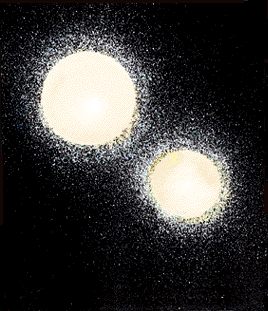 |
| The macabre Will-o-wisps from AD&D - The Balls of Steel - |
Until then,
Valete!
If
you liked this post, you may help me improve by sharing it in your
social networks. Also, if you are curious, give it a look
at my others works and
consider becoming my
patreon.
Subscribe to:
Comments (Atom)